03 Methods of translating
WRITTEN RESPONSE
12/11/2025
Structure: Raymond Queneau, excerpts from Exercises in Style, [1947] 1998 [pdf]
Method: Raymond Queneau, excerpts from Exercises in Style, [1947] 1998 [pdf]
Main argument: Our content is, perpetually, Design itself.
Designer Version
Form follows content. Designing the form changes how the content is perceived. In that sense, form itself is content. The positioning of our design within the spectrum of content and form reflects our authorship. In creating the poster for the film, I experimented with different methods of translation, reshuffling visual elements to communicate selected content from the film. Using the identity of the author helps rethink the form itself, reminding us that the way we structure visual elements is already producing meaning (Rock, 2009).
Author Version
The concept, story, and message together form the content. I decide the shape of the content, how it is structured, and the perspective through which it is presented. Authorship lies in the decisions I make: which parts to highlight, which to reduce or remove, and how to arrange them on the canvas. These decisions shape both the piece and my authorship, including its final form. The act of choosing, ordering, and framing content is inseparable from the content itself (Rock, 1996).
Audience Version
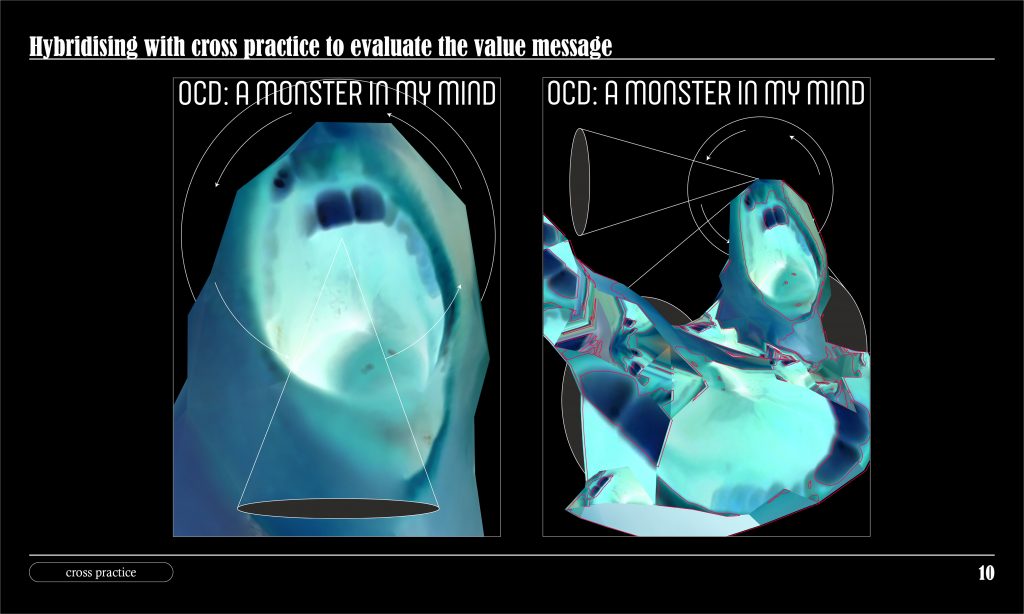
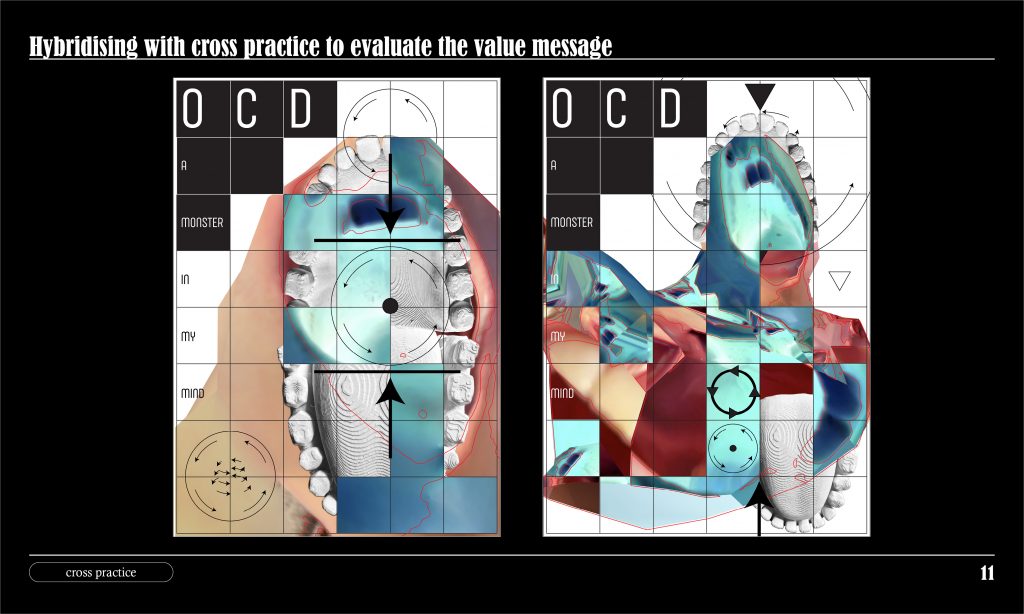
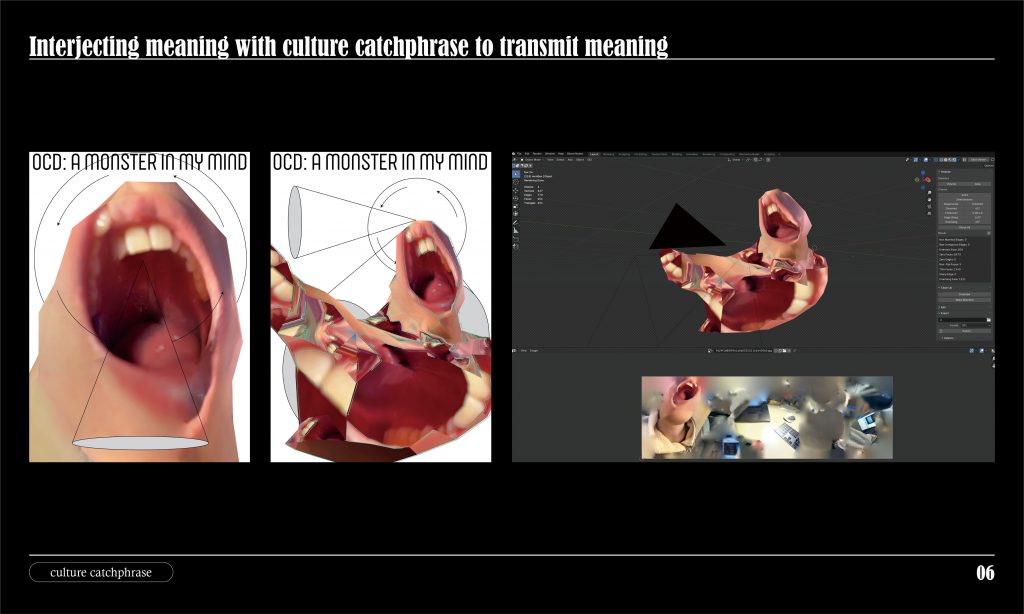
I feel the poster for OCD: A Monster in Our Mind communicates the feelings and struggles of someone with OCD through edited visuals. The twisted materials forming the mouth suggest pain; the diagram hints at how OCD operates. The design translates selected content from the film into a new, re-organised content with a new perspective. This reinterpretation allows me, as a viewer, to experience the original content through a lens shaped by the designer. Every visual language decision, marks her authorship and guides my perception.
Poetic Version
The author creates content, the designer shapes it, and the audience receives it through perception. The process is like swimming along separate currents: each stroke overlaps, blends, and moves the water in unexpected ways. Where the water finally rests that is the authorship. Form and content flow together, inseparable, always generating meaning. The water is never still; it traces the paths of thought and choice, folding the content into its final form (Queneau, 1947).
Translator Version
The designer is a translator, converting the language of the film into the language of the poster. Story of the film where visualised metaphors: crawling skins, itchy tooths, diagrams, and grids resembles the anxiety of OCD patient. Translation interprets meaning, emphasising what the designer deems essential. The poster communicates the film’s ideas in a new medium, producing a hybrid content: both the original film and the designer’s interpretive lens. In this act, authorship resides in the translator’s choices, shaping what is communicated and how it is received.
References (Harvard Style)
Rock, M. (1996) ‘Designer as Author’, in Multiple Signatures: On Designers, Authors, Readers and Users. New York: Rizzoli, pp. 143–150.
Rock, M. (2009) ‘Fuck Content’, in Multiple Signatures: On Designers, Authors, Readers and Users. New York: Rizzoli, pp. 173–179.
Queneau, R. (1947) Exercises in Style. Translated by B. Wright. London: John Calder, 1998.
WEEK 1
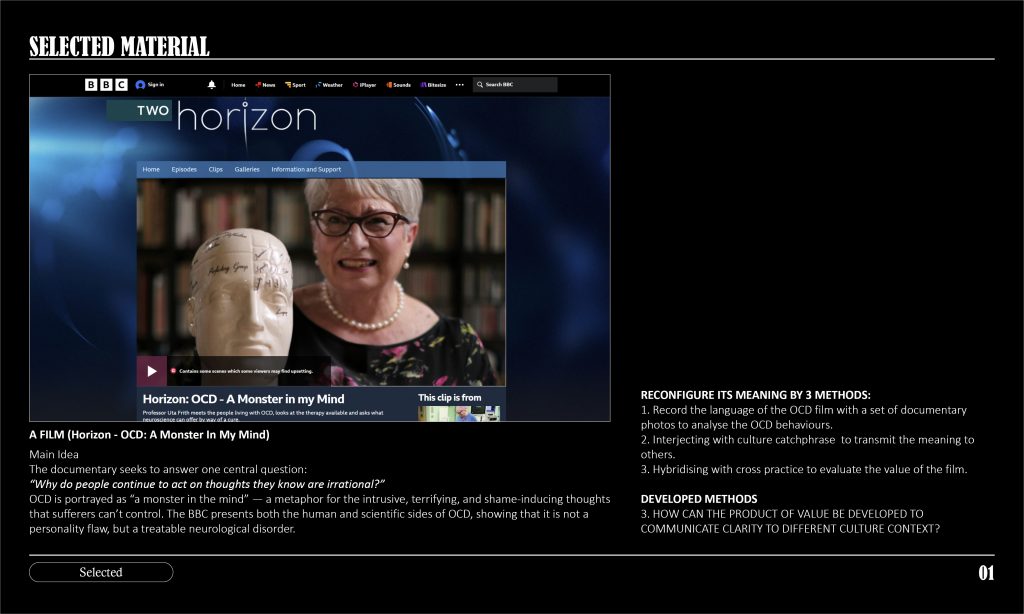
I chose a BBC film Horizon OCD: A Monster in My Mind as the subject of my translation project. This film explains what obsessive-compulsive disorder (OCD) is through real patient stories and scientific research. It shows the difference between OCD and normal behavior, and presents the latest treatments and research progress. From the film, I could feel the patients’ emotions of discomfort and struggle, and I also learned about the physical symptoms of OCD. I tried to translate these emotions and experiences in three different ways:
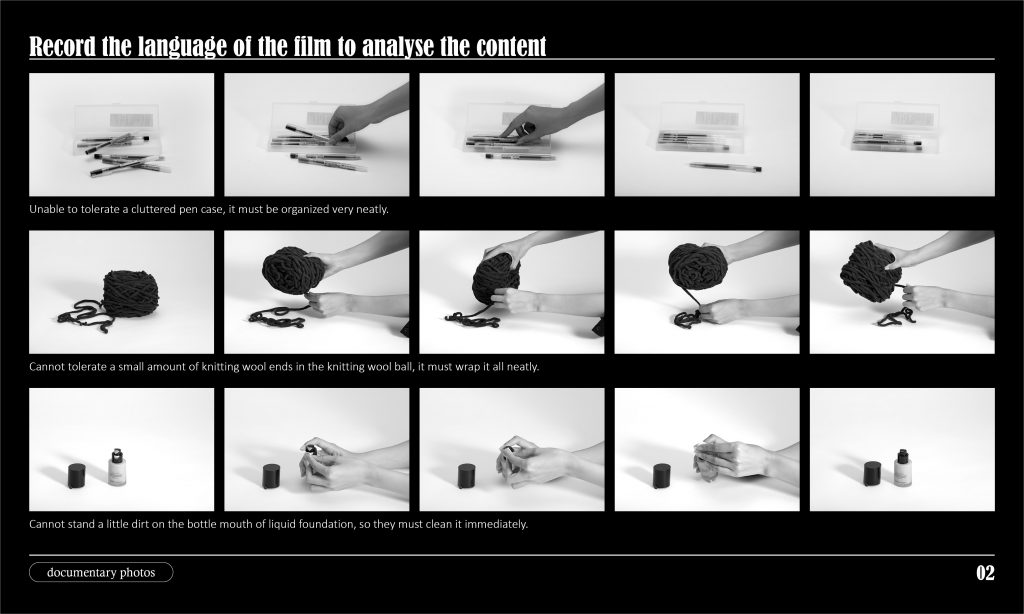
For the first approach, my keywords are record, language, and analyze.
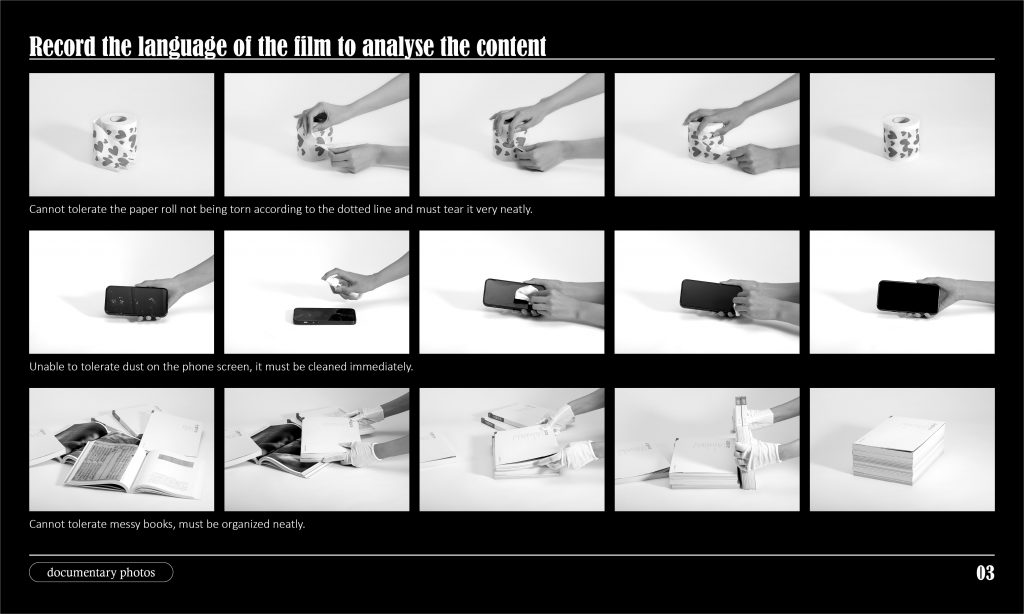
I first tried to record OCD in the simplest way which by photographing behaviors that OCD patients might show. They often repeat certain actions uncontrollably until they feel that everything is “Riight.” Only then do they feel safe, because these are the rules they believe can protect them. Although this may look obsessive, it follows their own logic of safety and completeness.
Through this method, I wanted to analyze OCD behaviors. It’s not hard to see that they are always fighting with themselves,like saying “I must do it the right or safe way; if not, I must repeat it again and again, even if I already did it, I still keep checking until I’m exhausted.”
For the second approach, my keywords are interjecting, culture, and transmitting.
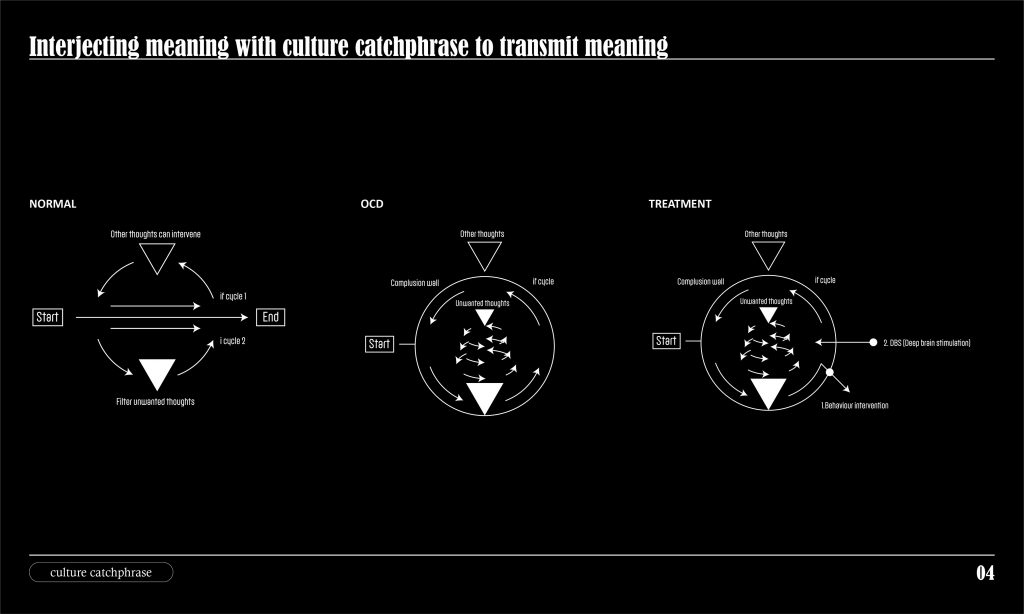
After watching the film, I organized and summarized its content. The film mainly discusses what OCD is, how it differs from normal people, and the current treatments. I translated these ideas into diagrams based on the concept of the thought processing system mentioned in the film. Since behaviors are influenced by thinking systems, I compared the thought systems of normal people and those of OCD patients in diagrams, which helps the difference becomes clear.
For most people, when something goes wrong, they can adjust, solve it, and then stop consciously. But OCD patients cannot stop — their minds hit a “wall” when they try to stop the unwanted thoughts. Useless information cannot be cleared out, creating a vicious cycle of endless repetition and exhaustion.
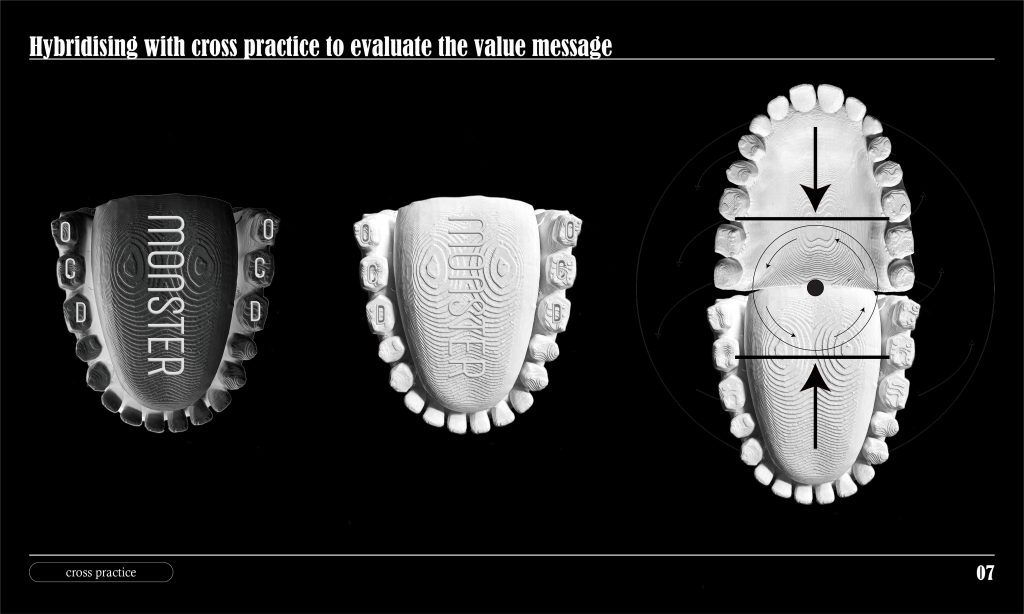
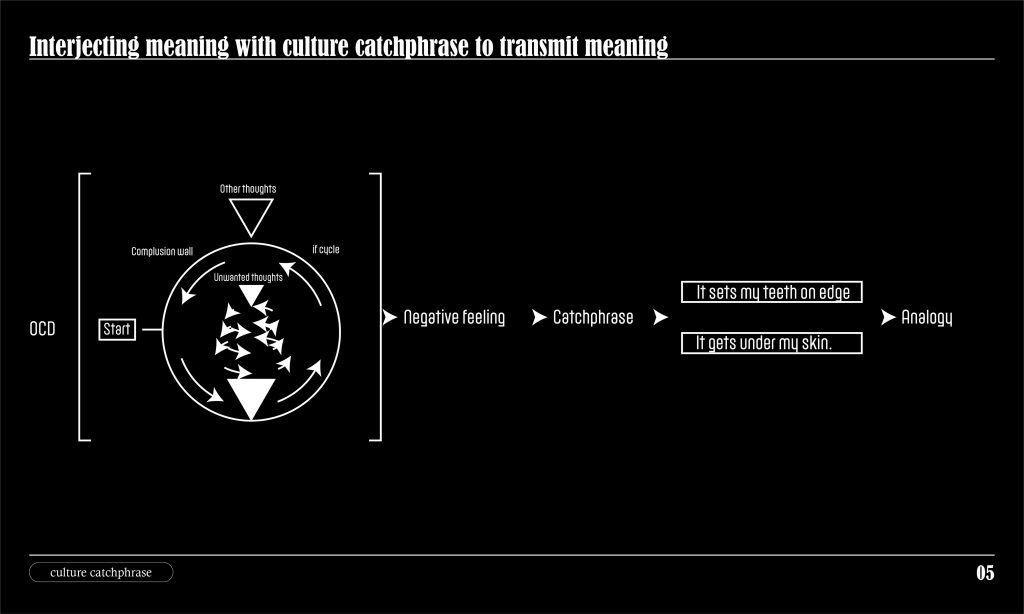
Turning this information into diagrams is an efficient way to deliver knowledge. However, diagrams cannot convey feelings. To translate and communicate patients’ emotions, I used cultural catchphrases as metaphors, such as “set my teeth on edge” and “crawling under my skin.” These phrases are commonly used to describe anxiety and discomfort, which makes them culturally understandable. A proper metaphor helps transmit emotions effectively. I visualized these metaphors by 3D-scanning my boyfriend and creating visual representations.
For the third approach, my keywords are hybridizing, evaluate, and value.
The core of the film is not only to educate people about OCD, but also to give hope to OCD patients. It shows that OCD is not incurable and reminds them that they are not alone in their struggle. I wanted to evaluate and translate this value through new media and contexts.
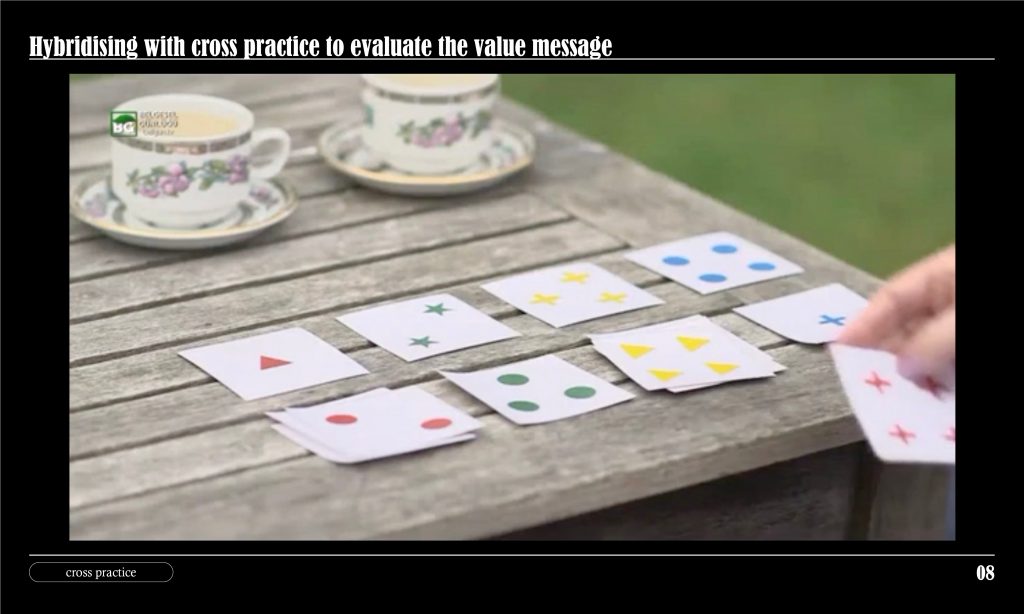
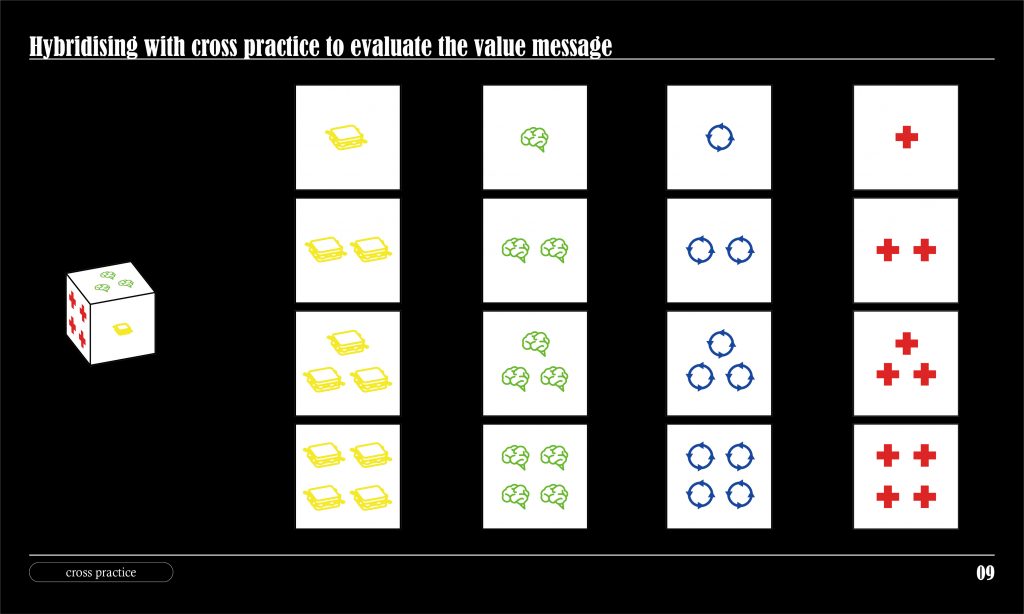
For example, I 3D-printed teeth and jawbones with text and images to express the idea that OCD is not a hopeless condition, though I was unsure how to continue this direction. Later, I tried another approach by using the Wisconsin Card Sorting Test (WCST), a test that examines flexibility in following changing rules. Since OCD patients often struggle with flexibility, I redesigned WCST as a new test by adding symbolic elements from different stages of the film and introducing dice to add randomness. I hope to collect feedback through this experiment.